Two suppliers can respond to the same request with prices that cover different work. Delivery may depend on an early order, installation may sit outside the quote, and support may expire before the planned period of use. A useful comparison preserves those differences while showing what each option would require from the buyer.
This is a business purchasing guide with a fictional cost example. The public bid tab is used to illustrate comparison fields, not to assess an award or claim a commissioned engagement.
At a glance
- Preserve the original offer and show adjustments separately.
- Compare the same outcome over the same period.
- Resolve the uncertainty that could change the choice.
Start with the requirement and its evidence
Write the quantity, specification, usable delivery date and completion test at the top of the comparison. Identify the version of the request and any clarifications. These fields establish what the buyer needs before the team starts adjusting prices.
Newport News Public Schools’ published July 2024 clear-backpack bid tab records unit prices, freight, totals, product-sample status and delivery dates. It also records delivery conditions tied to when an order or award notice is issued. Those fields illustrate why a price needs its surrounding terms. The tab alone does not establish a complete evaluation record or subsequent supplier performance.
For an ordinary business purchase, identify requirements that must be satisfied and preferences that allow a trade-off. Follow the established process for a public or otherwise regulated purchase; this guide does not set procurement rules.
Keep the quoted offer intact
Use one column per supplier and one row per requirement. Record whether each item is included, excluded, conditional or unconfirmed, with the quote page or written clarification beside it. Keep the original quoted total visible.
Add comparison adjustments in separate rows. If a quote excludes installation, obtain a price for that work or mark it unpriced. Do not enter zero because the supplier left a blank. An adjustment supported by another quotation differs from an internal planning allowance; label both and retain their sources.
Check the meaning of time commitments. Shipment, arrival and readiness for use can be different dates. A lead time that begins after approval of a sample needs that approval step in the schedule. Record quote expiry and dependencies that could change availability or price.
Show the cost of reaching the same outcome
Set a common review period and expected usage. Separate one-time purchasing and implementation costs from recurring charges and buyer-provided work. Include only relevant costs, but record material exclusions. Avoid adding freight, tax or support twice when already included in a package.
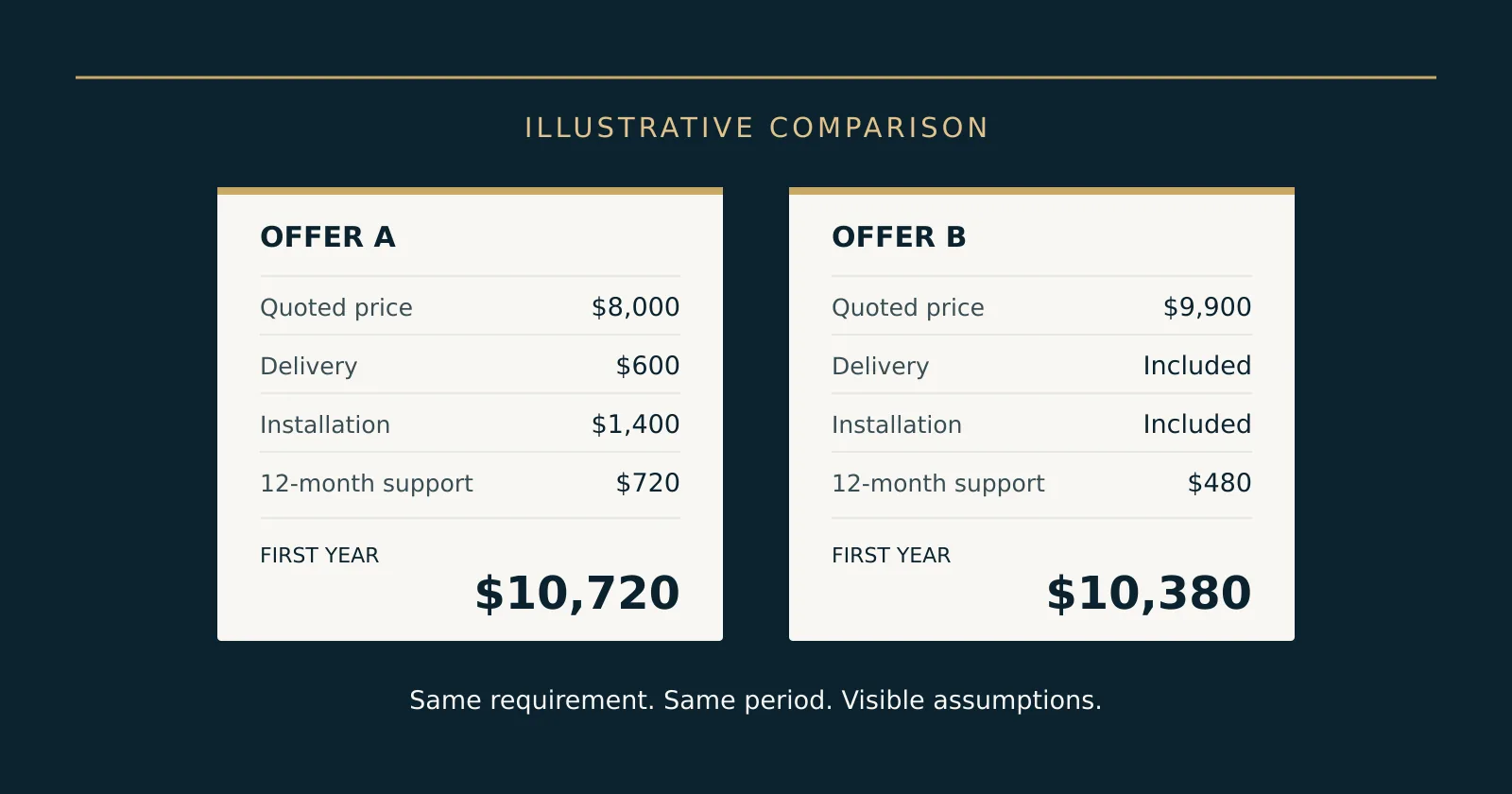
Consider a fictional first-year equipment comparison. Offer A is $8,000, plus $600 delivery, $1,400 installation and $60 monthly support: $10,720 over twelve months. Offer B is $9,900 including delivery and installation, plus $40 monthly support: $10,380. Assume the one-time figures include applicable tax, support prices are all-in, and both options meet the same requirement. B is $340 lower on this defined basis despite its higher initial quote.
This is an illustrative first-year comparison, not a lifetime-cost calculation or a purchasing result. A longer decision horizon would require further assumptions about maintenance, replacement, price changes and disposal. Show payment timing separately when it affects affordability.
Find the uncertainty that could change the choice
The GAO Cost Estimating and Assessment Guide connects reliable estimates with scope, schedule, a technical baseline, assumptions, data, sensitivity analysis and documented results. A small purchasing comparison can apply that discipline without pretending to have more precision than its inputs support.
In the example, suppose B requires buyer-provided site preparation that remains unpriced. Its apparent $340 advantage disappears if that additional work exceeds $340, all else unchanged. The next useful action is to confirm the preparation scope and price. A large generic contingency would obscure the specific question.
Keep nonfinancial requirements visible beside the cost comparison. A missed operating date or an unresolved acceptance requirement may determine feasibility. Do not convert every unknown into an invented dollar amount or let a combined score conceal an unmet requirement.
Carry the comparison into the purchasing decision
Finish with a short recommendation identifying the preferred option, comparison period, evidence, unresolved conditions and person authorized to decide. Retain the original quotes and clarification record so another reviewer can trace each adjustment.
Before commitment, confirm that the final written offer includes the scope and terms used in the comparison. If the supplier changes a material assumption, update the evaluation rather than carrying forward its previous ranking.
Give the receiving team the agreed completion checks and any outstanding conditions. A better comparison produces a purchasing instruction the team can use: what is being bought, what the buyer must supply and what evidence will establish that the promised result has been delivered.
Working checklist
- Dated requirement, quantity and acceptance test
- Quote version, expiry, inclusions and exclusions
- Delivery conditions and buyer-provided work
- Separate one-time and recurring costs over a stated period
- Sources for adjustments and clearly marked unknowns
- Decision-changing questions, owner and confirmation before commitment